Eight years ago I spent ten days in Amiens. I had great aims and ambitions. I wanted to explore how World War I changed the people and the landscape. I did a lot of research in Australia early on, which was just as well, because my body was beginning to ache at the seams and I could only do half the research. I did that half, and I also did the related research for a novel. That novel is timely now, for all the wrong reasons.
It’s about the Green Children. There are medieval tales of the Green Children of Woolwich, and they are oddly consistent. I wanted to add a pocket universe to the story and turn it into fantasy with a little bit of scientific underlay. The best place to do this wasn’t in England, where the story came from. It was in the Zone Rouge in France.
I wanted to understand how Jewish superheroes would create themselves if they weren’t strangers in a world full of hate, but refugees in a tiny universe where they were the majority. I wanted to see the stupidity that comes with confidence and being the centre of things, and to put a non-Jewish superhero at the heart of the story, showing how she saw the world around her and how she dealt with some really bad cards. In other words, I wanted to reverse some of our assumptions.
Part of this was asking, “What would our world be like with magic?” I’m an historian and for me there is not one simple type of magic, but complex systems that interact and that change over time. In my novel I used some historical systems and some less historical, and added a couple that only belong in that other world. If there are many systems and if they’re not simplified for ease of tale-telling then they leave more chaos in their wake when they’re abused. Also, how would magic be regulated? I used the UK for the regulation of magic, because I could bring important and old families into the story. Also because it means I could play in the wonderful sandpit of alternate history in London. Imagine a history of England where Jews were brought back in the 15th century? I wrote a short story to explain a part of this, and it was a finalist in the Sidewise Awards, which means… it’s Alternate History, even though it has magic. I rather like this. The story is in Other Covenants.
I lived in London and I lived in Paris for a little, many years ago, and, historically, London is a lot more fun for the type of story I wanted to tell. Pop-up history, small churches with pits to hell… I needed to know that terrain. I know the church in question (and its history) and I know the streets in question. This is not just due to having lived there for a little, many years ago. It’s because I used to teach students about medieval London at the Australian National University, and because I spent a whole day walking the whole of Cheapside because the maps of it showing it in the Middle Ages did not fit the modern maps. I took photos that document how and why Cheapside changed and can explain what this means to the wider City of London. I looked at the difference between Old Jewry, the newer Jewry where my family came from, and Golders’ Green. I walked all these places an took pictures, at various times.
A small US imprint published my novel as their first book. I never got to do a slide show of all the places and explain how the Somme and how London and Paris came together and how I used my historian-self to furnish the novel. Before the novel came out, I talked with a writers’ group about the layers of history in landscape and how war changed everything, using the Somme as a case study. Then COVID hit. Most novels published in the first two years of COVID are lesser-known. This doesn’t change the fact that my world-building for The Green Children Help Out was amazing fun.
What book should I introduce next week? Time-travel, magic in Canberra, non-fiction? I’m open to suggestions.
After reading the other morning, it occurred to me that we — in this case “we” means progressives who want a better country and are resisting the current destruction — keep trying to come up with fixes for our current messes that don’t change the system very much. So, for example, our ideas about health care are to imitate the European social programs and set up some kind of government-run single-payer system.
And while that’s not a bad idea as far as it goes and far more radical than anything that’s likely to happen anytime soon, I still have a feeling that we’re going to need something more than that, because our health care system is a colosal ruin.
Probably we have to start by recognizing how ruined things really are.
Tsing’s book uses the harvesting of matsutake mushrooms as a metaphor – or maybe a guideline – for dealing with with life in an area that has been ruined.
Matsutake only grow in the wild; they can’t be farmed. And they mostly grow in ruined forests, which is why there is a thriving business in them in the forests of Oregon, where the old growth forests were heavily logged. The timber companies replaced them with timber “plantations” of fir and lodgepole pine.
While this doesn’t make for the diverse and healthy forest that came before, it does provide an environment for the matsutake.
The matsutake are a delicacy in Japan, which provides a market.
There are many different kinds of pickers and also a variety of buyers who arrange the international sales. Many of the pickers are immigrants from various parts of Southeast Asia who were displaced by the U.S. war in Vietnam and other parts of the region, but even those come from different ethnic groups and have different approaches.
There are also immigrants from Latin America as well as some White native-born Americans, many of them war veterans who find holding regular jobs difficult.
But also – interestingly – there are Japanese Americans who approach this as a cultural activity, not a business. These are people descended from those who were interred in U.S. concentration camps during World War II. Their approach is quite different from that of the people doing it as a business.
The various immigrant cultures and their descendants are people figuring out how to survive after their worlds have been upended by war and economic crisis. Making a living finding mushrooms that grow in ruins makes sense in their world.
But for people like me, middle class though far from wealthy, the idea of surviving amidst the ruins that capitalism has wrought is scary. Still, when I look around me, I see those ruins everywhere.
I walk around Oakland, where ordinary houses sell for a million dollars (fancy ones for much more) and the rents for cafes and retailers are so exorbitant that far too many go out of business quickly. I see boarded up buildings everywhere alongside new apartment complexes — ugly ones, but still shiny.
Our city has been cut to pieces by highways running through it, tearing apart neighborhoods. Those highways and other badly planned projects add environmental ruin to the mix.
And of course, we have people living on the streets. Some have serious mental illness or addition problems, but a lot of them just don’t have the money for a place to live.
So much money and so much ruin, all at once.
It’s not just Oakland; I mention it because it’s where I live now and I know it. You can see it everywhere. Chris Brown’s book A Natural History of Empty Lots provides detailed looks at what creatures and plants are coming back in ruined urban landscapes, primarily in Austin, Texas.
Now I can see better ways of doing damn near everything and I would love to wave a magic wand and make those things happen. We have the tools, the resources, even the brainpower to make all this happen. Our problem has always been the will, particularly the political will.
I just read a book that took me forever to finish. As it was one of the many, many books I have to read as a World Fantasy Award judge the slowness of the read was a problem. Well aware of the stack of “to be reads” teetering in my room, I kept wanting to move faster. But I couldn’t. Why? It’s not a bad book, the prose is readable, most of the characters are interesting, the setting, based on an African culture, is intriguing and lovingly detailed. Sounds great.
But there was a pronunciation guide at the front of the book.
I am a whole word reader: what this means in practice is that I will note a word without hearing it (trying to learn to read using phonics slowed me down so much when I was a kid that I thought I was developmentally challenged). Even with names with multiple diacritics (signaling intonation, stress, and pronunciation) I sort of note the shape of the word and zip on past. Unless there is a pronunciation guide at the front of the book. For some damned reason, paging past that guide meant that thereafter, every time I encountered a name, I was compelled to page back to the pronunciation guide and see if I was reading the name correctly–even with the names with no diacritics. Nine times out of ten I was correct. The thing is, to get to the story and keep everyone straight, I didn’t need that pronunciation guide. So why is it there?
I generally find maps, lists of characters, explanations of social hierarchies, glossaries, and other world building stuff to be distractions. If they exist, I think they should be at the back of the book (yes, even those pages long lists of characters in Dostoevsky which I think must be provided lest the Western reader get tangled up in patronymics). I also tend to think, in modern fantasy, that these things signal, either that the author has not done a good enough job massaging the world-building into the text, or that the author is so in love with their world-building that they want everyone to see what they’ve created.
I recognize that impulse, believe me, I do. 9/10ths of the worldbuilding work I do when I’m writing second-world fantasy never makes it to the page, and yet it is work I’m proud of, and why can’t I show it off? But I don’t think it helps most books, and in some cases it actively hinders it.
In the case of this book, I think there may have been another reason for all this front matter. The author is writing for a Western audience that may not be (probably isn’t) well versed in her culture. In using a pronunciation guide she’s offering that audience an opportunity to learn her language, to get it right, to hear the names as if she was pronouncing them.
The problem is that, by doing this, the author privileged her desire that the reader get it right, over the reader’s (which is to say my) desire to stay in the story and get pulled along with it.
The presence of the pronunciation guide at the front of the book made it impossible for me not to check each time a name showed up. Why couldn’t I ignore the guide? I am not certain–maybe because for me it turned the book from a story to get involved in into a lesson. I realized the further I went, the more invested I was in sounding out the names–even names I was familiar with. I don’t think that’s what this writer intended.
Don’t get between me and your story, please. I’m distractible enough.
I promised to introduce my work, then got bowled over by my own urgent need to understand one small aspect of our current world. That aspect has changed my life in some important ways, and I suddenly realise that not many people know much about everyday life in Jewish Australia. This is not the first time I have suddenly realised this thing. Last time, I wrote a novel with magic and feminism and much discovery of lost culture and foodways. It also contains prophecy. In fact, I wrote The Wizardry of Jewish Women.
There are three different sets of Jewish life in the novel.
One is like quite a few friends in my Jewish circles, with a mild religious sensitivity and a vast desire for community and understanding and service. Belinda in Canberra could easily have been part of my Jewish community, twenty years ago, before I was too ill to do everything. I asked permission from a friend to use her garden in the novel. She had a spectacular garden. We knew each other through dancing and through a women’s group, mainly. Belinda has the gardening and the cooking and the care. She’s someone everyone should meet.
The second drew on the knowledge and experience of a group of Jewish (but not practising) friends who I did women’s stuff with. Judith in Sydney is my readers’ favourite character. Her politics and the deep wish to improve the world were core to my life 25 years ago, though she’s a bit more left than I was. I can’t do these things now because, simply, most of the women who used to love working with me have dumped me for being too Jewish.
It’s all post October 7. They would have dumped Judith, too. She would have failed their purity test by being too Jewish. Judith would have waxed delightfully sarcastic and been very upset. She would have been especially upset because no-one would have asked her what her views were. She would simply have been left out of everything. Now is not then, and Judith is way political in Wizardry.
The third is what happens to an Australian with Jewish ancestry who has retained key aspects of the culture but not the religion or the family. What does Rhonda share with me? She’s an historian.
Each of the three women inherit something that was considered very standard for Jewish women in medieval France: magic. Each of them does quite different things with this inheritance. I wrote their stories because I wanted to meet them. I still do.
Lots of things make me angry these days. We’re living in those times, the ones where if you’re not mad, you’re not paying attention.
But the ones that make me furious on a visceral level are the ones where some misogynist expresses hatred or disdain for women or sets out a plan to strip away our rights.
That’s when I see red, when I’d really like to confront one of them in person and get them to throw a punch at me so I can throw them into the nearest wall.
Now that’s not a healthy response. I mean, I do know how to slip a punch and throw someone, but I also know that when things get physical someone could get hurt and it could well be me. I’m old and while I know something about fighting, I don’t have the illusion that I’m a superstar.
It’s just that the hatred and the contempt bring out my desire to not just tell an asshole that he’s wrong, but show him by dealing with him on that physical level where way too many men are wrongly convinced that they’re better than women.
I don’t just want to beat those men. I want to humiliate them. I want them to know they’re inferior to an old lady.
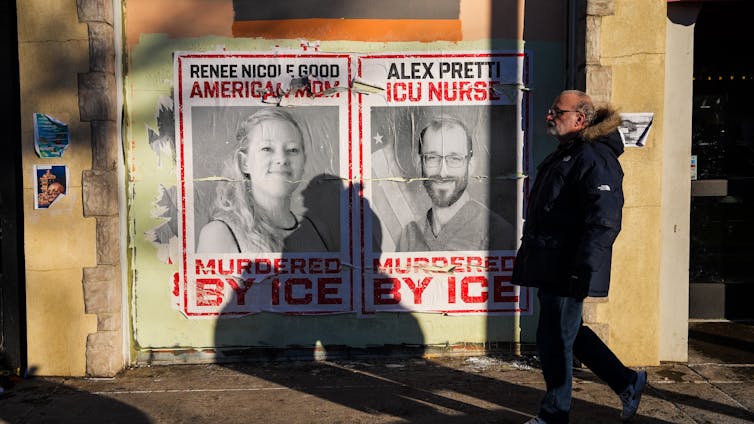
Neither of them was the first person to be shot and killed by immigration enforcement officials over the past year. There have been numerous shootings and some deaths.
In September 2025, Silverio Villegas González was killed in Chicago under circumstances similar to Good’s death. Ruben Ray Martinez was shot multiple times by Immigration and Customs Enforcement agents in Texas in March 2025, but their involvement was not revealed until nearly a year later. Neither Martinez nor Villegas González has become a household name, and their deadly encounters with federal agents have not drawn nearly the same level of media attention as Good’s or Pretti’s.
As a media historian, I’ve been struck by the similarities between the media’s coverage of Minneapolis and its coverage of Selma, Alabama, in 1965, when voting rights protests led to violence that left three people dead, including two white victims.
These two events reveal that the deaths of white activists often draw and sustain far more attention than the deaths of Black or Latino people in similar contexts. But the Selma and Minneapolis events also show that male and female white activist victims aren’t necessarily treated the same way.
Remembering Selma
Video footage of law enforcement beating and gassing marchers on Selma’s Edmund Pettus Bridge remains an iconic visual document of the Civil Rights Movement. John Lewis, who later became a congressman, was an activist at the head of the march on March 7, 1965, and was beaten in the head at the base of the bridge by Alabama state troopers. But he was not a household name in 1965, and media coverage at the time did not identify him.
Reporters also didn’t pay much attention to what had motivated the march: the killing of Black voting rights activist Jimmie Lee Jackson by an Alabama state trooper during a nighttime march a week earlier.
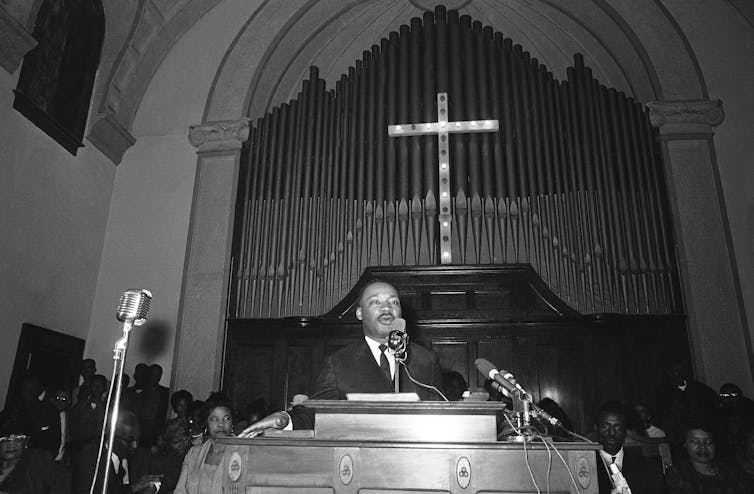
Martin Luther King Jr. delivers a eulogy in Selma, Ala., for James Reeb, a fellow minister who was beaten to death. AP Photo
Still, the prime-time television broadcast of footage from “Bloody Sunday” at the Pettus Bridge shocked Americans, just as footage from Minneapolis has similarly distressed and disturbed many people today.
In 1965, a small number of white Americans from around the country, including numerous members of the clergy, descended on Selma to stand with the brutalized voting rights activists. They included James Reeb, a Unitarian minister from Massachusetts, and Viola Liuzzo, a wife and mother of five from Michigan.
President Lyndon B. Johnson contacted Reeb’s widow. She gave media interviews about her husband. Johnson also extolled Reeb at the beginning of his joint address to Congress calling for robust voting rights legislation, four days after Reeb’s death. Johnson never mentioned Jackson’s death.
Liuzzo was ferrying people back to Selma from Montgomery on March 25 after the conclusion of the final, successful march to the state capital when a carload of Ku Klux Klansmen, one an FBI informant, chased her down and shot her through her car window. Her death received even more coverage than Reeb’s, keeping Selma in the news.
So how does coverage of Reeb and Liuzzo echo the portrayals of Pretti and Good? And why does it matter?
Initial media treatment of Liuzzo focused on her status as a wife and mother. She was characterized as brave, putting the rights of others above her own. “Mrs. Liuzzo ‘Felt She Had to Help,’” was the headline of a New York Times profile.
But in both cases, although separated by six decades, condemnation, disparagement and misogyny soon followed. Government officials, commentators and far-right forces framed these women and their activism in darker terms. Liuzzo was smeared by a KKK grand wizard who blamed her for her own death, saying, “If this woman was at home with her children where she belonged she wouldn’t have been in any jeopardy.” Liuzzo was falsely accused of having sexual relations with a Black man, thereby being characterized as a traitor to the white race.
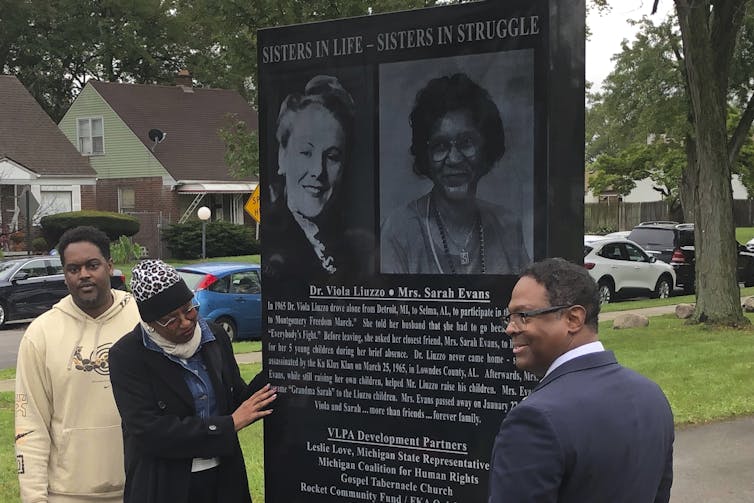
In 2023, a Detroit monument honoring Viola Liuzzo, who was killed by the Klan, and Sarah Evans, who raised Liuzzo’s children, was unveiled. AP Photo/Corey Williams
Official government and law enforcement responses to Good’s death echo the Liuzzo case; in fact, the responses have arguably been magnified. Vice President JD Vance blamed Good for her own death, claiming it was a “tragedy of her own making.” President Donald Trump characterized her as “disorderly” and vicious. Homeland Security Secretary Kristi Noem and other administration officials labeled Good a domestic terrorist.
This attempt to influence the media’s framing of Renee Good clearly had an impact, since much of the early media coverage focused on questions about her actions and motives, with the New York Post derisively labeling her an “‘ICE Watch’ ‘warrior’ who trained to resist feds before shooting,” before attention shifted to Pretti’s killing.
Good, like Liuzzo, was also derided as a race traitor, somehow betraying white Americans by supporting nonwhites. Podcaster Matt Walsh disparaged her for giving her life “to protect 68 IQ Somali scammers,” a smear that made its way into mainstream media, including its appearance in an opinion piece by The New York Times’ columnist David French that criticized inflammatory MAGA rhetoric.
Men have been treated differently in both press coverage and political response. Reeb, a father of four, never faced the level of condemnation heaped on Liuzzo. Southern white segregationists certainly questioned the motives of the many clergy members who descended on Selma. Those sentiments, however, did not circulate much outside of segregationist press. Reeb’s status as a minister, along with being a white man, may have shielded his reputation.
Here’s where there are some similarities to the response to Pretti’s death. Initially, Trump administration officials brought out the same playbook they’d used with Good. Noem and Stephen Miller, the White House homeland security adviser, called Pretti a domestic terrorist. Greg Bovino, the leader of Operation Metro Surge in Minneapolis, along with a Homeland Security spokeswoman, claimed Pretti intended to “massacre law enforcement.”
Like Good, Pretti became the target of vitriol in far-right media platforms. But little of that has gotten much purchase in mainstream media, just as the segregationist contempt for activist clergy members in Selma was not amplified.
Pretti’s status as a licensed gun owner who was exercising his Second Amendment right to bear arms, as well as his First Amendment rights to protest, may also have assisted his posthumous reputation. Right-wing critics who condemned a lesbian who was not adhering to a set of standards regarding femininity had a much harder time condemning a man licensed to carry a gun.
Liuzzo, Reeb, Good and Pretti all put their bodies on the line and made the ultimate sacrifice on behalf of vulnerable nonwhite people. Liuzzo and Good suffered significant character assassination that their male partners-in-protest avoided.
Whiteness may help bring massive media attention, but being a dead white woman doesn’t necessarily bring respectful treatment. For some, especially those who put their bodies on the line for nonwhite communities, they are just “AWFL,” the current right-wing acronym for “affluent, white, liberal women” who step out of bounds.
This is a post from my blog, from 9 years ago. I’ve very mildly edited it. There are two reasons for sharing it with you.
The first is that I have an intermittent fever and that my body feels as if someone is attacking it with a sledgehammer. The illness will be gone in a couple of days, but today I’m not up to much.
The second is that sometimes it helps to see the paths our current problems have travelled. I’ve been dealing with some of the current issues all my life, and yet those who have not tell me it’s all Israel’s fault and our society has nothing to do with the discrimination it carries nor the hate embedded deeply. This is a snapshot of my Australia in 2017, when Australia was adapting some of the positions that dominate today. Most of those who saw me as painted now exclude me because I’m Jewish, for instance. Almost the whole Left (where I used to belong) tells me what I am and ushes me aside or, in some cases, do things that are much worse. I was never given the academic support to sort everything out properly (I came close), but I have moved a lot further towards understanding. I may talk more about this when I explain my books. I’ve already been explaining what those 9 years have led to, for Jews – today you see one single aspect of how it came to be.
Next week I will try to return to talking about my own books, including the one that led to this post. First, however, I need to be less ill.
Right now, the results of my research force me to reassess the world around me. This reassessment shows remarkably clear indications of how perfectly nice and thoughtful people help set up a complex culture from which bigots can source hate. Now that I know a bit more about where it comes from, I need to take a pause in my research and digest it.
I’ve written a summary of key aspects of my latest findings for those who want, and that summary has tentatively been accepted for publication. Watch social media, for I will announce it when it emerges. Beyond those findings, the project might have to wait for years. This post is a bit about the project and a bit about why it’s delayed. And how I’m living the life… but not in the way anyone expected.
Quite simply, if I get the right kind of job then I can do the full academic shebang and hit the subject hard and sort it out. I know what I’m doing and how to turn it into a book. If I don’t get the right kind of job, then slow and gentle is all I can manage, with occasional reports like this one and very occasional conference papers. I’ll be able to teach from it, and each course will be exciting and amazingly useful. That’s all, though. No book. Very few articles.
For those who have seen my work so far and have said “But this is important”, I’m sorry, but I can’t do that kind of research in my current situation. Income matters. At the very least, some of my results will appear in my fiction, for my fiction continues without money. More slowly than if I had money, but it continues.
This knowledge is based on experience. Putting other peoples’ intellectual wishes first has not helped me get enough money to live on, so I now put my own needs first in my big life decisions.
There’s another reason for putting my own needs first in those big life decisions. My research has pointed to a bunch of narratives that set up society to exclude perfectly good people and to nurture bigots. I’m right now observing how it hits the disabled and the cultural and religious minority and gender minorities. I’ve now realised how much my own life in Canberra is affected by this.
It’s complicated, but there are two main outcomes.
The first is that many Canberrans exclude me by making decisions for me regarding what activities they expect from me in my life. Some of the reasons are probably excellent. I don’t know. I don’t know what those reasons are. I am to them sufficiently lower in status to not need an explanation or consultation.
The second is related. One of the most annoying aspects of being minority right now is that earned status is difficult to retain unless one is the token representative of that minority. So in Canberra (but certainly not in all other places) I often have to negotiate work as if I were new to the workforce. And I’m one of the lucky people in my lack of seniority, for who else at my level of the hierarchy has two PhDs and whose short list of publications is four pages long? (there is no long list – I dumped it when my short non-fiction hit the 500 mark, which was while ago) And I have friends, who help. And patrons. And I’ve managed to get to several conferences this year, despite living on around $20,000 annually.
Usually these two factors lead to both exclusion and silencing. I keep pointing out that other people who are excluded are silenced more effectively. I can be left off this list or that, but I still get invitations to write and I still have things to say. This is one of my privileges. (and now I’ve used loads of current jargon – such virtue!)
Taking things back to my research for a moment, I’m talking about these issues today because I found a gap in my knowing. I need to find out if that same gap is present elsewhere, especially in my interpretation of how wider culture affects story. I need to look at who is allowed in a group and who isn’t in novels and other long stories.
I noticed something interesting in The 100 today. Skin colour counts in US tales. This isn’t new. This isn’t what I noticed. What I noticed is that focussing on US definitions of racism and silencing and exclusion to assess who got killed under what circumstances made me miss something else.
In our fiction, our central characters have certain types of personalities. It’s as if they come from a range of action or emotional figurines. We take them out of the box and play with them. Those who lack those characteristics are painted figures on the back of the box. They don’t get full lives. Most people define themselves as the figurines when they place themselves in story, as people with full lives. What I think I’m seeing is how people define those who are merely figures. And I’m seeing the circumstances when I am a figure, left behind when the figurine is brought out to play but considered to be part of the backdrop. I’m not seen as excluded because of my painted role, but my role is limited to being in the backdrop of the lives of others.
Like all of us, I carry my own prejudices and see other people as active in my life (figurines) or as backdrop (painted figures). My personal need is to find out who I see as painted figures and give them the dignity of full lives if I’ve excluded them due to prejudices I bear. I also have to accept that a lot of people who were once close to me have, in the change of culture, shifted me to the painted figure category. They want me on the back of their box to illuminate their life, but they don’t want to have dinner with me. I need to accept that some of this is due to prejudice.
As ever, this is a simplification. I needed a quick and dirty overview so that I could start to think how we do what we do.
I wanted to use the circles shutting people out that are described in Joan G Robinson’s When Marnie Was There. Anna was excluded by these invisible circles and, re-reading the book today, they felt very familiar. The subjective feeling of being excluded by invisible circles, however, rests on whatever draws those circles. In my childhood, it was a primary school child whose name I mentioned the other day to my oldest friend. She laughed and remembered, with equal irony.
This is our old way of seeing it. It works when we move from circles to circles and when we see individuals as having to deal with being alone but assign them equal status as human beings. It’s well encoded and very well described. This means that it’s a part of what’s happening culturally right now. A part. Not the whole thing. For culture is changing. We need to encode the changes. That’s what I’m doing here, but it’s a rough sketch. I need something better than toy figurines and the drawing on the box.
This means it’s back to novels. We encode cultures in the nice straightforward framework of the novel. This means that I can find out a lot about what’s happening around me by looking closely at how we depict ourselves and what we write into a story without knowing. The most worrying discovery so far is the one I explained in my Helsinki paper. The Helsinki paper isn’t for publication yet. This isn’t because it’s bad research. It’s because that paper encapsulated the moment when I realised just how big the thing is that I’m doing and how large its ramifications.
I wish I had that fulltime academic job. I wish that researching this didn’t have to come at the end of the month, after everything else. I only do the amount I do because I’m efficient at it. I can’t spend large amounts of time in archives and libraries right now for I simply need to spend that time earning grocery money. That’s my lifestyle problem.
My scholarly problem right now is that, with this strange lifestyle, I’m carrying too much baggage. I can’t do the research partly because I need income, but the lower status lifestyle gets in my intellectual way. The life carries emotions with it. Every time I’m excluded I feel them come to the surface, for I need to explain them.
Those emotions are why I’m not making as much sense as I’d like tonight. I’m in the middle of big things, intellectually, and my life echoes them.
As most readers know, I’m a volunteer along with more than a hundred other people at Unbreaking.org, which currently describes itself on the main webpage as
Documenting damage and resistance. Unflooding the zone.
I signed up because I have lots of writing and editing experience, but once I started looking at what needed doing, I realized that a skill I first learned in law school and honed in my years as a legal editor at BNA was particularly valuable: I can look at court documents of all kinds and figure out what’s going on and what’s important about it, if anything.
What this means is that I’ve not only been paying attention to the legal news – which I’d do anyway because looking at legal stuff is the easiest way for me to understand what’s going on – but actually reading about some cases in detail, particularly ones related to the security (or lack thereof) of people’s data.
This is work that is both inspiring and depressing.
It’s inspiring because so many lawyers and judges are working so very hard to combat the ongoing destruction of our democracy and the parts of our government that used to work pretty well.
Every time the grifter’s government does something outrageous, somebody sues. Our attorney general here in California has brought all kinds of cases, usually in company with attorneys general from other states. For example, they’re suing – and winning so far – over efforts to shut down food stamp payments in states that refuse to hand over data on food stamp recipients.
Several clinics and hospitals that do gender-affirming care have fought back when they got subpoenas from the Justice Department demanding that they turn over data on their patients and won.
And 29 states and the District of Columbia refused to provide voter rolls. They’ve been sued for those records, but so far the courts are ruling in their favor.
It’s interesting how many of the cases revolve around the government trying to get their hands on data about citizens and how strongly some of the states and their lawyers are protecting that data.
In a reasonable world, the federal government would be interested in protecting the data of the people who live in this country, but in the mirror world we live in they’re out to exploit it or use it to harm us.
But it’s still depressing. Some of that is just the mind-blowing things we’re having to fight about. It’s also the knowledge that the Supreme Court is packed with right wing extremists.
I mean, I was glad they threw out the tariffs, but that was one small victory from a court that has overwhelmingly ruled in ways that undermine our democracy.
I am volunteering twice a week at an elementary school in downtown San Francisco, and enjoying it immensely. Part of what I enjoy is the roughly ten minute walk from BART to the school, which takes me through a somewhat rough neighborhood which is slowly turning around. There are a couple of nail salons, and a couple of coffee shops, one of which I have been eyeballing since I first started volunteering in October. I haven’t been in yet, and today I realized why I stare wistfully at the door but don’t go in. It’s partly a Me thing, but partly a Them thing.
In terms of the Me thing? I sometimes have a problem going in to stores and particularly restaurants where I don’t know the lay of the land. I have largely overcome this, but I can recall times in my life where I would walk by a restaurant six or seven times before deciding I just… couldn’t. It’s the same thing that happened to me (way back in the Pleistocene era) when I had to make a long-distance call for the first time, one of those calls where you had to ask for operator assistance, and the phones had rotary dials, and the world was a sweeter and more innocent place. I have vivid memories of being nine or ten, trying to call my grandmother (or perhaps my mother who was visiting my grandmother) in far away Los Angeles, and putting it off and putting it off because I would have to ask the operator for assistance and I just… couldn’t. I couldn’t admit that I needed the help, because what if she said no? (It would have made no difference to me to have it explained that it was the operator’s job to help me, that she was waiting, hopeful that I would ask for her assistance, etc.) I was ashamed of needing help making a phone call that could not have been made in any other way at that time. So that’s the Me thing.
But the Them thing? This is a very hip establishment located on the bottom floor of what I think used to be (by the look and layout) a small manufacturing business. 20 foot ceilings, large open space, decorated in industrial chic (pipes and ducts are a feature, not a bug). It looks like it would be a nice place to sit and read or get some work done. There are seats by the window, a scattering of two or three tables, then a long, curved wooden counter with seating on one side, which surrounds the roasters and attendant equipment, and more curved counters to the rear… but no immediate visual information about where the hell to order your caramel macchiato with two shots. I look in the cafe window and imagine going in for a post-kindergarten-chaos latte, but I can’t imagine where I’d order it. The layout is too cool to be visually parsed from the street.
I wonder if this is deliberate. In my most self-deprecating moments, I imagine they want to discourage aging neurotics from messing with the vibe of the place. More realistically, I suspect that whoever designed the layout was thinking about that vibe, but not about human behavior. This happens with some designers: my first job, I worked at the Harvard Graduate School of Design, in a huge, award-winning poured cement building that was always glacially cold, and where the famous glass ceiling over the vast studio area routinely leaked all over the desks when it rained. The building looked really cool, was much admired and, as I said, had won awards. But no amount of award-winning design can compensate for a little commonsense planning.*
I am going to go get a coffee there. I swear. The designer’s unwillingness to create a space that welcomes a passer-by will not defeat me, so long as I am able to defeat my own unwillingness to ask for help. If possible, I will refrain from standing in the doorway yelling “where the hell do I order my coffee?” Wish me luck.
_____ * I worked in the basement of the building, and one day heard streams of profanity issuing from down the hall. When I went to investigate I found an HVAC technician who explained, when I asked, that the Air Conditioning unit had died. It had been installed after the building foundation had been poured; then cement floors were poured on top of it. This might not have been a problem except that the unit was enormous, and the doorway that had been specified was not large enough to allow the old unit to be removed, or a new unit to be brought in.
It’s Purim, there’s a war on, and antisemitism is shifting and… I need a break. My Purim is splendid, full of friends and food, but it’s not traditional. We meant it to be traditional, but last night my friends and I needed to talk and to understand. So much of our everyday is unsafe and difficult and last night the Purim meal brought people together who’d seen different sides of similar problems. There was comfort in knowing that healing can happen, but the Megillat Esther and getting drunk didn’t happen. We drank, but the issues we talked about were so intense that the drinks weren’t refreshed more than twice.
Tonight will be more traditional, but still, the comfort is in the friends this year, not the tradition. The left in Australia sill blames Jewish Australians for anything they think is wrong with the world. I’ve taken to calling this a cultural form of colourblindedness, because those who don’t choose hate but accept it may not be doing it intentionally. If they do it intentionally, I will criticise that, but who does it help when you point to a wall and say, “Do you love the colours?” and all they see is grey. My resolution for this year was to see humans for their humanity and only place blame when a given person has earned it.
I need a book or TV show to back up my new metaphor and of course I have one. The Stargate series manages to incorporate an astonishing amount of (admittedly mostly half-baked and often wildly stereotyped) mythology and history and culture. There’s no Australia, and there are only modern US Jews. Even rebellion in Ancient Egypt is Jew-free. It’s not one of the shows that intentionally shares hate. It draws on all the normal cultural stereotypes and has an archaeologist with three PhDs to explain them. I suspect the Jewfree ancient world was a matter of cultural safety, because explaining early Christianity as alien might not go down well, but when I watch it back a quarter of a century or so later, All I see are vast gaps in logic and common sense and history. So much of who we are is because groups interconnect. Cultures seldom operate in isolation. The Jews of history are some of the great connectors, whether in the Ancient World, the Medieval, or right now. It’s what happens when you combine diasporic culture with a high level of literacy.
Leave any culture out and there is a hole. Leave the cultures and people who connect with others, or are foundational for modern culture and things fall to pieces f you look too closely. That colourblindedness is a problem when the colours are critical to history as we know it. In Australia, many in the 19th century saw a Terra Nullius and destroyed so much. With Jewish history and Jews… I could talk for days about what people think they see when they don’t see us. Or people who want Jews dead to get rid of the annoying discrepancy between what they see and how the world works.
And this is why Stargate is comfort food. It doesn’t work at all if you look too closely. This is a good reason to sit down with some popcorn and let reality do its own thing for a couple of hours. I can’t save the world, but I can rest from it in a world that cannot exist.
PS I used a German sour cherry jam for Hamentaschen. I can’t buy it locally but, in case you’re wondering, if you use puff pastry for hamentaschen (some years I do and some years I don’t) it’s the best filling.


 I am volunteering twice a week at an elementary school in downtown San Francisco, and enjoying it immensely. Part of what I enjoy is the roughly ten minute walk from BART to the school, which takes me through a somewhat rough neighborhood which is slowly turning around. There are a couple of nail salons, and a couple of coffee shops, one of which I have been eyeballing since I first started volunteering in October. I haven’t been in yet, and today I realized why I stare wistfully at the door but don’t go in. It’s partly a Me thing, but partly a Them thing.